Writing
English at EHPS is aspirational, enriching, inclusive, enjoyable and enables children to express themselves.
Intent
English at EHPS is aspirational, enriching, inclusive, enjoyable and enables children to express themselves and communicate effectively.
At East Hunsbury Primary School, we intend for our children to leave Year 6 as confident, capable, independent writers who not only understand the purpose and importance of writing within wider society but they also positively engage in the process. We intend them to leave our school with all the writerly skills necessary to thrive within Key Stage 3 and beyond. We intend for our children to be able to communicate and express themselves effectively through the written word across both fiction and non-fiction; including being able to write for a range of purposes and audiences. We intend for our curriculum to cultivate an enhanced sense of autonomy and authorship in the young whilst being inclusive and enriching.
We intend for our children to take risks when writing; seeking to be original and creative as well as critical and reflective. We want our children to draw upon a rich exposure to quality literature so that throughout the writing process they can write as a reader and read as a writer, thus acquiring more ideas to manipulate and apply.
Throughout their time at East Hunsbury Primary School, we intend our children to be exposed to an ambitious and enjoyable curriculum which covers a range of: plot patterns, text types, composition foci and genres for them to not only grow as writers but also develop culturally, emotionally, socially and spiritually.
Aims – every child a writer with agency
The aim of our writing curriculum is to promote and attain the highest standards of writing to enable children to be effective communicators in both fiction and non-fiction and leave EHPS as a writer with true authorial agency.
We aim for the children to be able to:
-
Write fluently and accurately for a range of purposes and audiences across a variety of genres and text types
-
Take risks to create original, effective and creative pieces
-
Select their words carefully to create a given effect
-
Employ a wide, but effective range, of vocabulary in both fiction and non-fiction
-
Understand the importance of reading on their writing
-
Learn from other high-quality authors and use this to influence their own writing
-
Understand the role of writing on their lives and wider society
-
Engage in discussion to learn, deepen their thinking and form opinions
-
Choose what they want to write, who they want to write it for and what form it will take.
-
Identify themselves as writers, understand their rights as writers and their authorial intentions.
-
Enjoy and be enriched by the curriculum.
EHPS Agreed Pedagogical Principles for the Effective Teaching of Writing
Our aims are then supported by our agreed set of pedagogical principles that we believe underpin the effective teaching of writing which are being developed with staff during the academic year 2024-25. Teachers will create a writerly children.
Implementation Overview
We use the following methodologies for the transcriptional aspects of writing throughout the school:
-
Handwriting Kinetic Letters
-
Phonics and Spelling Sounds-Write1 (see reading strategy for further information)
-
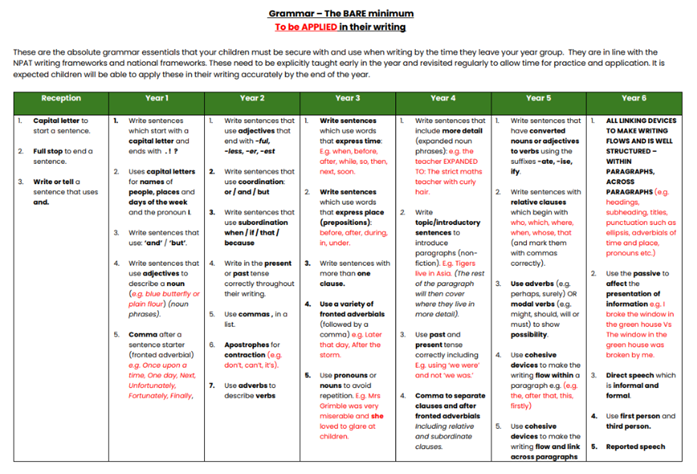
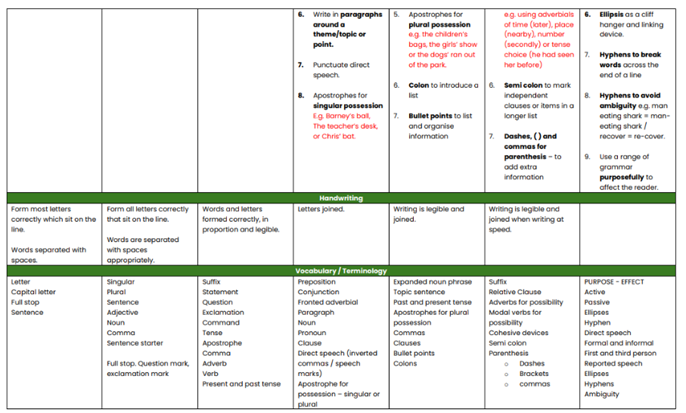
Grammar Pie Corbett Grammar Progression Document which has been
written in consultation with teachers and in-line with the National Curriculum. Added to this is a Grammar Essentials progression document, which highlights the fundamental grammar skills that children need to master as confident and fluent writers written and developed by our own staff but inline with NC expectations.
Composition
At East Hunsbury Primary School, we use the Talk for Writing (TfW) approach across our school as our methodology to teach children to become independent, confident and creative writers. Talk for Writing is impactful because is based on how children learn and is rooted in research and best practice. The inclusive approach moves children systematically and supportively from being a dependent writer through to an independent one and complements our reading strategy – they both strengthen one another. Oracy and reading are central to the TfW process and it equips children with the skills of cohesion and composition. Talk for Writing also supports children with English as an Additional Language by immersing them in our language and scaffolding the acquisition of it. Click here for more information on what Talk for Writing is.
The strategies that teachers explicitly teach through the Talk for Writing process are:
-
Modelling
-
Selecting, judging and applying linguistic devices and words for effect.
-
Demonstrating
-
Evaluating
-
Memorising
-
Instructing
-
Recall / revising
-
Innovating – manipulating what they know to create something new.
The Talk for Writing strategy is based on three stages: Imitation, Innovation, Independent Application - which moves children from dependence into independence.
During the year, each year group will teach approximately 6 units of work; three fiction and three non-fiction. Mini units are interspersed throughout each year plan which covers toolkit work, poetry and invention. The sequence is punctuated with regular opportunities for short-burst writing and an emphasis is placed on activating passive vocabulary.

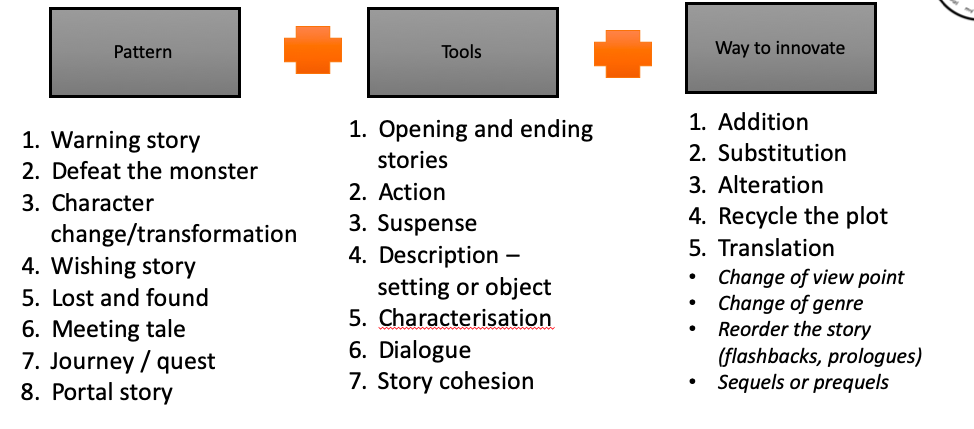
During each fiction unit, the children will learn:
-
how the story is structured / organised (the plot pattern)
-
how to write effectively focusing on an element of compositioning. setting, action, suspense etc. (writerly toolkit)
-
a way to innovate (e.g. substitution, addition, translation, change of viewpoint and/or genre)
-
During each non-fiction unit, the children will learn:
-
how the text is structured/organised
-
how to write effectively focusing on the linguistic and grammatical devices the text type demand
-
how to write accurately and informatively using a given conten
-
a way to innovate (e.g. substitution or addition)
-
The TfW process is cumulative and progressive so children’s writerly competencies develop and strengthen their ability to structure, compose and innovate will become more sophisticated and complex. Children will learn how to become a ‘writer’ and the skills surrounding collecting ideas, drafting, editing and publishing.
We have progression documents in place for non-fiction, composition toolkits and grammar to ensure composition is taught at ARE or beyond. These documents also support the teacher’s subject knowledge and pitch.

Our writing curriculum is underpinned by reading as we believe reading feeds the writing. As such, throughout the writing curriculum children will explore a range of models from high quality texts alongside the unit’s ‘model text.’
The quality of the models provided is pivotal to the success of the sequence and the writing and as such these have been written and/or selected by expert teachers.
The writing curriculum is sequenced so that it is cumulative, whereby the children’s knowledge is constantly revisited and built upon. It has also been designed so that, in non-fiction, once the skills have been learnt there is an expectation that they will be applied across the curriculum.
Writing is taught daily across the school and additional spelling and grammar lessons are planned in when, and where, necessary.
This diagram explains the planning that is in place to support the implementation of the curriculum’s intent and the whole school overview. These plans are all available within the school’s English Team’s folder.
Long Term Yearly Overview
For every year group, a detailed long-term overview which clearly explains prior and future learning alongside age-related expectations. The document details unit outcomes, relevant supporting literature alongside the model, focus and plot pattern being taught.
The grammar expectations for each year group are then included and it is expected that through diagnostic assessments teachers will weave in the grammar into the units of work so that it is taught contextually. In many cases the unit of work are complemented by the Talk for Reading units as we believing that the reading feeds the writing.
Additionally, cross curricular links are plotted to ensure that children apply non-fiction writing in the context of a discreet subject
The long-term and yearly overview will be evaluated on an annual basis taking into consideration impact on learning and feedback from pupils and teachers.
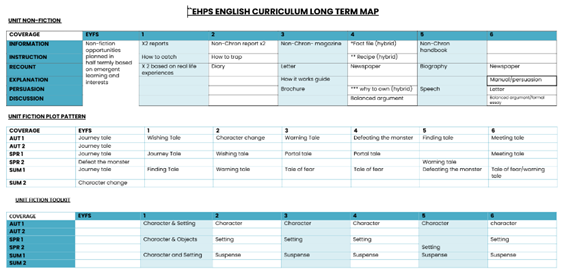
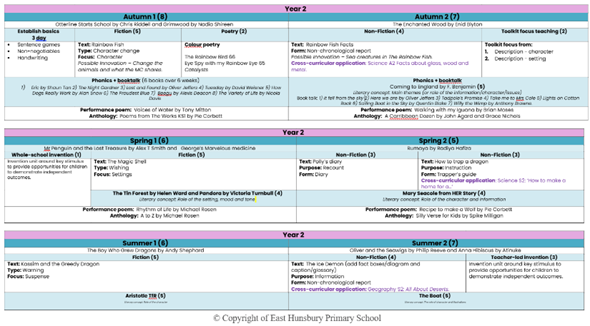
Detailed planning for units is archived in the English folders for teachers who wish to access fine planning detail and unit overview.
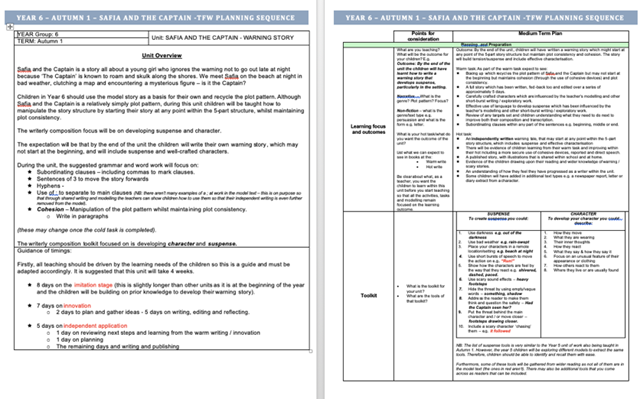
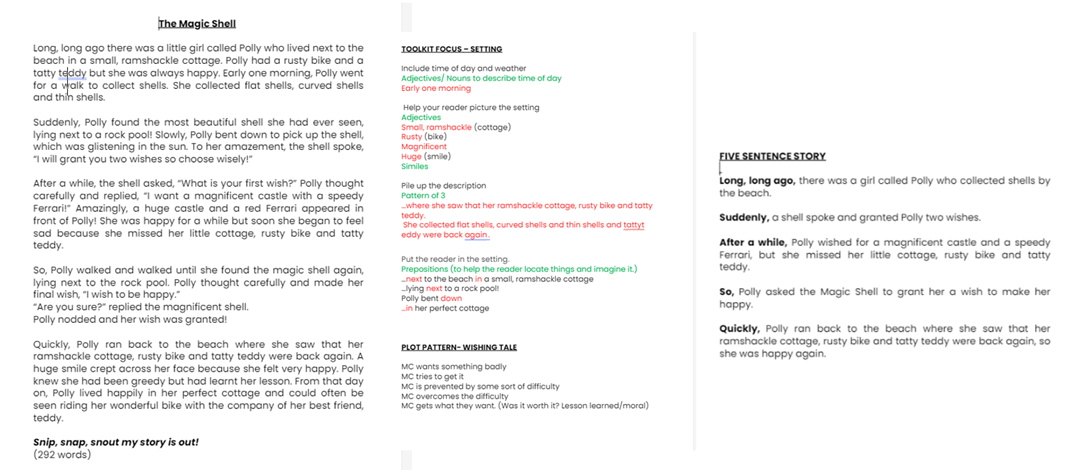
Every unit, in every year group, has a document with the model text, suggested elements of the toolkit for that init, plot pattern or structure and a five sentence story. Teachers use theis document to plan, or modify, the unit, which follows the journey from start to finish as shown below. Teachers select a 25, 15 or 10 day planto suit the planned length of the unit as indicated in the long term map.
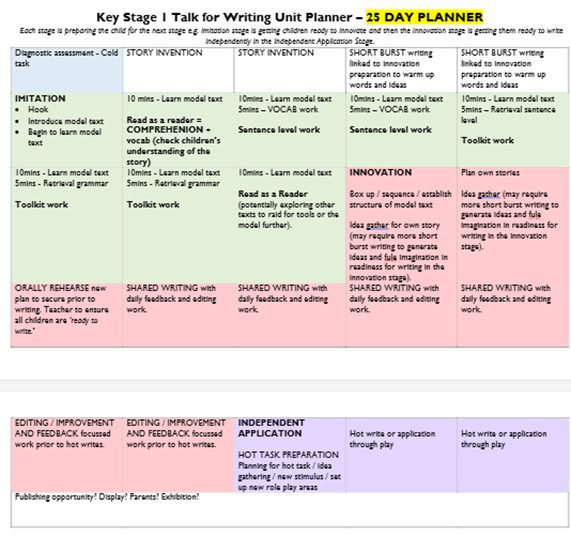
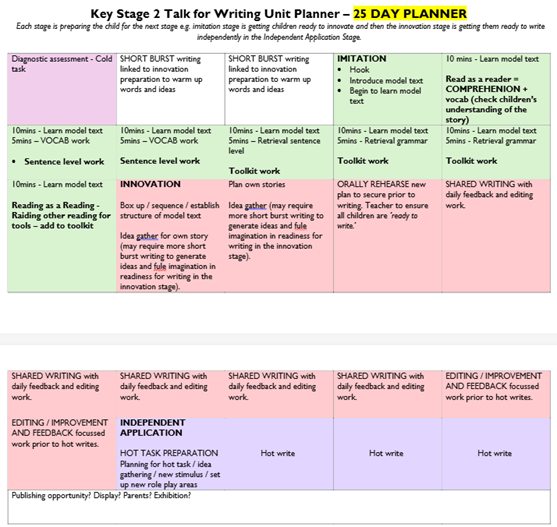
Refer to our Early Writing Curriculum document, which can be found in our Curriculum section of the website, for more information on the pedagogy and methodology of our approach to teaching early writing.
Intent
We are an inclusive school, and our curriculum is inclusive by design. At the centre of the Hive curriculum is the Talk for Writing strategy. Our intent is that our learners develop a love of story and to experience high quality texts that will develop their receptive and expressive language and for their learning opportunities to be immersive and memorable.
Implementation
Working with Jane Ralphs, Talk for Writing’s SEND specialist, we have created a curriculum using the Talk for Writing Approach that is adapted for pupils with SEND. Following the 3 I’s of Immersion, Imitation and Innovation the children learn to progress their receptive and expressive language at a rate and stage that is appropriate to them, individually.
A teacher in the Specialist unit is a member of the TfW team and works closely with the teachers in the Specialist Unit to amend the approach to suit the diverse and individual needs of the children. Talk for Writing will feature as an anchor in their curriculum and be a thread that unites mainstream and The Hive. Development work in 2025-26 with a SEN specialist Talk for Writing consultant will move the strategy forward to embed.
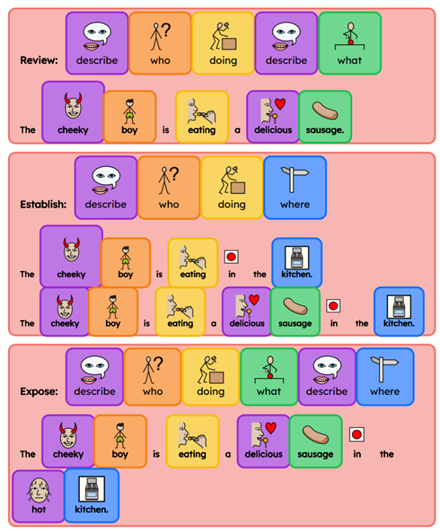
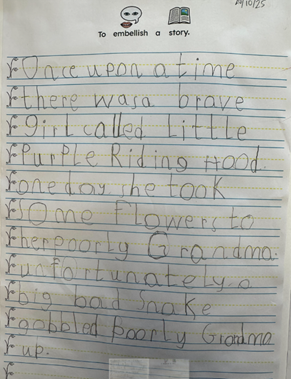
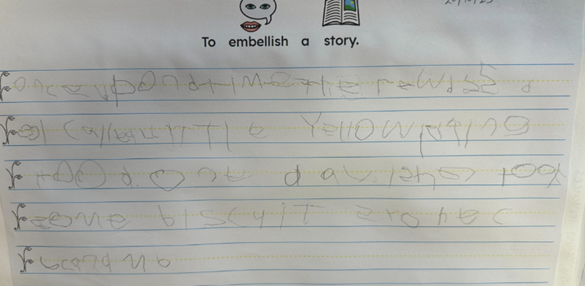
To develop sentence level writing in our Hive, a progression of key sentence building helps teachers to pitch teaching to suit the individual needs of both classes and individuals so that all children experience success as emergent writers.
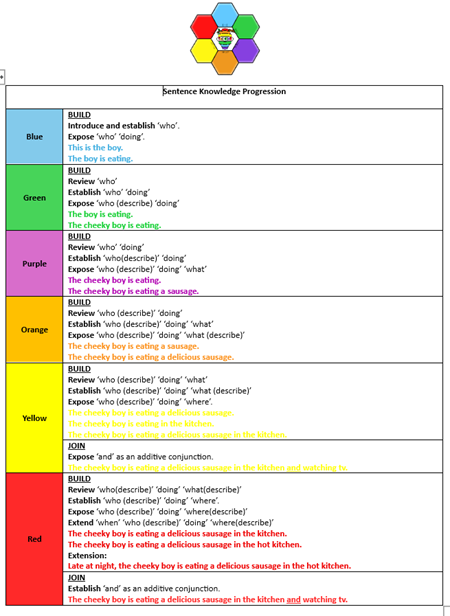
Impact
At the heart of our approach is the belief that the journey through story to develop receptive and expressive language, will permeate confidence in the use of everyday spoken language and support the transcription of sentence and simply written forms.
 |
 |
See The Hive webpage for more information about how writing is taught and assessed.
Embedding British Values in the Writing Curriculum
British Values—Democracy, Rule of Law, Individual Liberty, Mutual Respect, and Tolerance—are integrated into writing to shape children’s perspectives, encourage critical thinking, and develop their voices as responsible citizens.
Democracy in Writing
Children express opinions, listen to different viewpoints, and engage in persuasive writing. Writing letters, speeches, and opinion pieces fosters participation and respect for diverse perspectives.
Rule of Law and Structure
Understanding writing rules mirrors the need to aspire to positive outcomes. Children learn structured writing, grammar, and text organization, reinforcing discipline and fairness.
Individual Liberty and Creativity
Encouraging free writing, storytelling, and poetry helps children to develop unique voices while exploring themes of personal freedom and responsibility.
Mutual Respect and Collaboration
Collaborative writing, peer reviews, and discussions promote respect for different perspectives. Exploring diverse cultures through writing builds appreciation for others.
Tolerance and Diversity
Exposure to literature from different backgrounds cultivates empathy. Writing from various perspectives helps challenge stereotypes and encourages inclusivity.
By embedding British Values in writing, children become expressive, open-minded individuals who understand language’s role in promoting respect and unity.
Protected characteristics
Our primary school writing curriculum embraces protective characteristics to promote inclusivity and respect. By encouraging diverse perspectives, empathy, equality, and a supportive learning environment for all students is built.
By the time the children reach the end of our writing curriculum, they will have experienced a rich variety of the finest literature, they will have written in a range of text types and for a variety of different audiences and purposes. The impact of the curriculum will be that they become an effective communicator through the medium of writing, have developed authorial agency and are able to engage in meaningful discussions about their own work and the work of others.
Writing evidence will be recorded in writing books.
Writing will be assessed using:
-
Diagnostic assessment of the cold task.
-
As the EEF states:
High-quality assessment and diagnosis should be used to target and adapt teaching to pupil’s needs. Rapid provision of support is important but it is critical to ensure that it is the right support. Diagnostic assessment can be used to inform professional judgment about the best next steps. Diagnostic assessment makes teaching more efficient by ensuring that effort is not wasted on rehearsing skills or content that a pupil already knows.
-
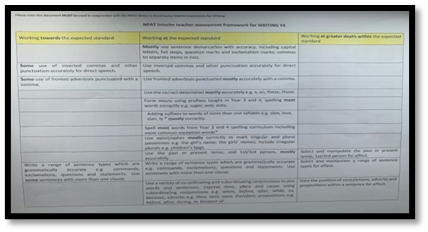
The Independent Application task(s) – Hot task which is completed by pupils at the end of each unit- teachers must use this to assess the impact of the teaching and use the NPAT teacher assessment framework (see below) to support any judgements made.
-
The NPAT Teacher Assessment Framework for each year group will be routinely cross-checked by teachers both at moderation and as an assessment tool when analysing outcome of the children’s hot tasks. This assessment document will be used to moderate and standardise our assessments both within school and across the Trust.
-
Use of the school’s Primary Writing Toolkit folders which is a body of work produced by HfL and published by Collins. This toolkit supports teachers planning, assessment and moderation of writing alongside the NPAT Teacher assessment Framework.
-
Cross-curricular writing as detailed in the long-term plan. Here the teachers can assess the application of non-fiction writerly skills in a newly learnt or revisited concept.
-
Whole-school and cluster / academy writing moderation led by teachers in school one of which is an SLE.
-
No more marking assessment – comparative judgement
-
Pupil voice and surveys will help us understand how children perceive themselves as writers and value writing.
-
Year 2 and Year 6, TAF (teacher framework) and exemplification documents are used as a reference during the in-school moderation of these specific year groups.
-
Quality Assurance of writing is completed by the writing lead alongside the writing team and class teachers during data entry times.
The way in which we assess children as writers will be routinely monitored to ensure that the information we gather is appropriate, useful and impactful on teaching and learning.
The writing leader, along with phase leaders, will work collaboratively with all staff to offer bespoke support in order to continually improve practice. Leaders will identify any support required through skills audits, team meetings, staff and pupil surveys, learning walks, monitoring systems and the standard of work in books and classrooms.
Appendix 1: Grammar essentials LTM
Example of model text, toolkit and scaffold for a year 2 unit

Appendix 2: examples of literature to support British Values
Democracy
-
The Day the Crayons Quit – Drew Daywalt (Encourages discussions about fairness and having a voice)
-
We Found a Hat – Jon Klassen (Explores taking turns and making fair decisions)
-
Duck for President – Doreen Cronin (Introduces elections and leadership in a fun way)
Rule of Law
-
What If Everybody Did That? – Ellen Javernick (Explains the impact of following or breaking rules)
-
Officer Buckle and Gloria – Peggy Rathmann (Emphasizes safety and why rules matter)
-
No, David! – David Shannon (Discusses consequences of breaking rules)
Individual Liberty
-
Giraffes Can't Dance – Giles Andreae (Encourages self-expression and confidence)
-
The Dot – Peter H. Reynolds (Promotes creativity and believing in yourself)
-
Be Who You Are – Todd Parr (Celebrates diversity and self-acceptance)
Mutual Respect and Tolerance
-
The Name Jar – Yangsook Choi (Teaches respect for different cultures and names)
-
Elmer – David McKee (Promotes inclusion and valuing differences)
-
Last Stop on Market Street – Matt de la Peña (Encourages empathy and understanding)