The Nest Curriculum
The NEST provision at East Hunsbury Primary School is a specialist provision for children with additional needs, predominantly those with and Autistic Spectrum Disorder (ASD) diagnosis. Children who attend The Nest must have, or be on the way to receiving, an Educational Health Care Plan (EHCP.)
We work closely with Speech and Language, Occupational Therapy, Play Therapists and Autism specialists to ensure that The Nest is a language and communication rich environment.
Our curriculum is adapted to suit the individual needs of our pupils and is not only underpinned by the Characteristics of Effective Learning but also our values and drivers which are unique to our school and setting. Our values and drivers have been carefully chosen to ensure that the curriculum is taught in a way that meets our children’s learning and SEMH needs (Social, Emotional, Mental Health) and prepares them well for the next phase of their education and lives.
We learn and work closely with our peers and colleagues in the Hive and Mainstream to ensure that we operate as one school.
Intent
It is the intent of our curriculum to adapt and scaffold the East Hunsbury Primary School Early Years Curriculum in such a way that our learners can access it and feel belonging within it.
Building on research and guidance from specialists such as SALT professionals and Autism consultants. We intend for all learners to access the curriculum at a level which is individual to them and appropriate to their developmental stage.
The NEST is a mixed age setting, Year R – 2, learning is tailored to a child’s developmental stage rather than chronological age.
Our values and drivers underpin all teaching and learning in our setting:
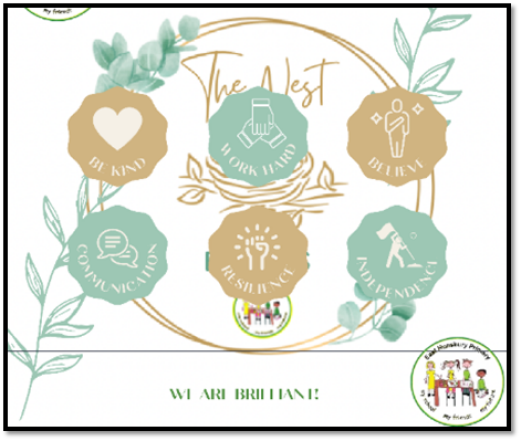
Drivers: communication, resilience, independence
A curriculum driver is a thread, or ‘vehicle,’ that runs through our teaching and learning, it drives our provocations and stimuli and underpins our exploration of the interests of our children.
It is our intention that these drivers are evident throughout our curriculum and influence all the teaching that happens at East Hunsbury Primary School.
Independence
Rationale: We want our children to be as independent as they can possibly be. Leaving us with the skills they need to attend to their own needs and to communicate with others.
Aim: We aim for our children to be:
-
Independent in self-care
-
Independent communicators
-
Independent in choice of activities.
Communication
Rationale: we want our children to be able to express their wants and needs through a Multi modal communication model.
Aim: We aim for our children to be effective communicators through; verbal, pictorial, technological means and/or through Makaton signing.
Resilience
Rationale: We want our children to display resilience when performing daily tasks. Our focus on this area is based on Ruth Ginsburg’s work on the 7 c’s of resilience:
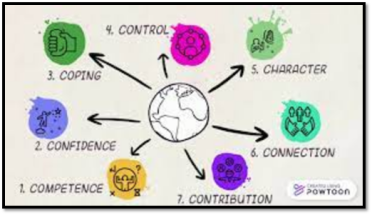
Practising these skills in the safety of our setting will allow our children to take them forwards into their daily lives.
Aim: We aim for our children to be resilient learners who display; competence, confidence, coping, control, character, connection and make contributions.
Environment
It is our intent that the environment within The NEST is language rich and calming, so as not to be overstimulating to our children. The decor is neutral and minimalistic, removing distractions and helping our children to focus. Multimodal communication such as Widgit and TOBI symbols, communication boards and Makaton signing are evident throughout.
A Dark Den and sensory corridor are also available to address the sensory needs of our learners. Each learner has their own TEACCH workstation to allow them time and space to work on independence skills.
Implementation
The NEST ensures that pupils are offered personalised learning from teachers and support staff who are well-trained in providing specialist education. The NEST is committed to matching teaching and learning to pedagogy and to deliver a rich, inclusive, befitting curriculum that results in brilliant outcomes.
The uniqueness of our setting allows us to tailor our teaching and learning to our pupils as individuals, considering advice from external professionals, research in the field and targets from individual EHCPs. Where possible, we follow the teaching of the mainstream Reception classes, adapting the curriculum to best suit our needs. Our class-based teaching is based on the TEACCH approach, and our timetable provides flexibility for us to address the sensory needs of our learners through Rainbow Room, Ryme Time, specialist tennis coaching, Forest School, Yoga, Sensory Circuits and access to the sensory room. Individual needs are also met through targeted intervention of Attention Autism and Intensive Interaction.
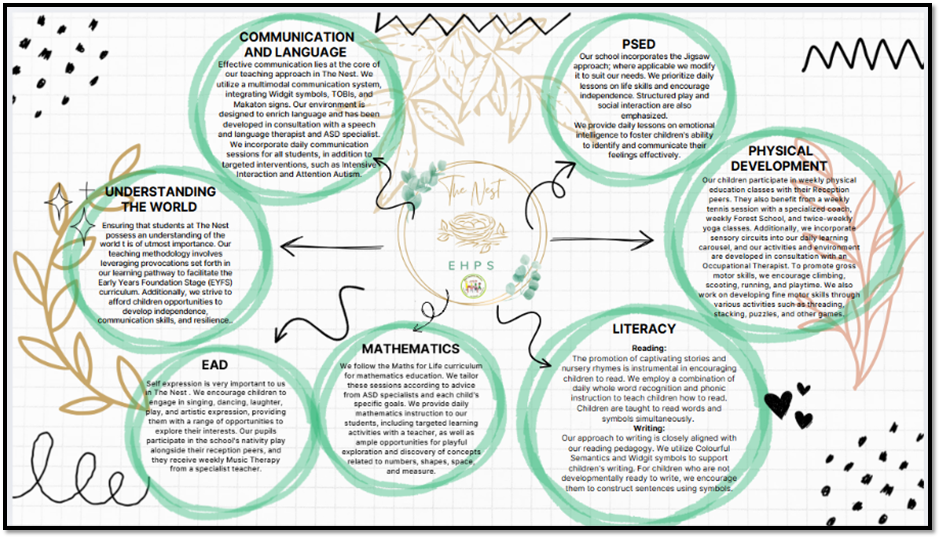
Implementation of Drivers and Values
Our Drivers and Values are focused on throughout all our teaching. Independence is focused upon in daily tasks such as eating, toileting and changing our clothes, as well as through focused play sessions. Communication is at the heart of all we do, every day starts with a focused communication session where our children are encouraged to share their feelings and make simple choices. All sessions are tailored to suit individual communication needs and children are encouraged to communicate with pictures, symbols, gestures and signs. Including the use of targeted AAC such as PECs and Communication Boards. Resilience is encouraged and developed through 1:1 and small group teaching of play tasks and challenges, children are encouraged to keep trying until they achieve a desired result, and all their contributions are valued.
Phonics and Handwriting
Phonics, and handwriting be taught using whole-school carefully researched approaches; Sounds-Write and Kinetic Letters respectively. Children who are in the pre-writing stage will be supported by: “Write from the Start” and “Colourful Semantics” interventions. All these approaches are based in sound pedagogy and are appropriate to the age and developmental stage of our children.
Early Reading
Early Reading is a crucial skill; it has been recognised by many educationalists as a key component to learning. Phonics is a large part of this in the early years, but reading is so much more than simply being able to decode words. We appreciate that the phonic approach is not always the most effective when teaching Autistic children and so teach Sounds-Write alongside The Wellingborough Programme for whole word reading and adapted symbolled books that use the PECs approach. When teaching reading, we want to promote a love of books and an understanding of the text. Children will hear multiple stories, poems and nursery rhymes every day at East Hunsbury Primary School; we will read class stories, picture books and non- fiction texts.
Reading for pleasure will be promoted in variety of ways including library visits, books in all areas of the provision, story play and storytelling, weekly library books and sharing children’s and teacher’s favourite books.
Sensory Curriculum
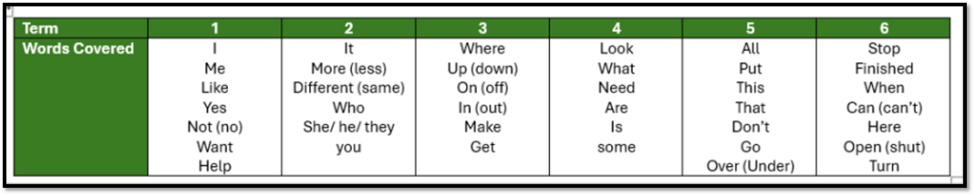
Many of our ASD learners are whole-word readers, because of this we also follow Sensory Classroom’s Sensory Curriculum, this approach teaches one whole word per week through multi-sensory methods. These words are matched to a core-word board AAC and can also be uploaded to electronic AAC devices.
The words covered are:
Learning Journey
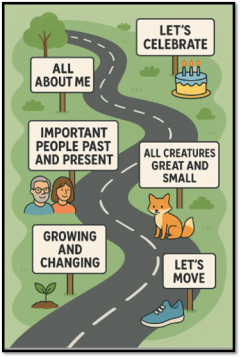
To ensure that all areas of the Early Years’ Foundation Stage are covered, we have mapped out our ‘Learning Pathway,’ this will be informed by the children’s engagement and involvement and is designed to evolve with our children.
These are linked to allow for joined up thinking, supported by research in Cognitive Science, allowing for retrieval practise and interleaving to become a part of daily teaching and learning.
Through these provocations and the exploration of the interests of our children we will ensure that they can discover and experience a variety of cultural opportunities to help them all progress and achieve success.
Talk for Writing
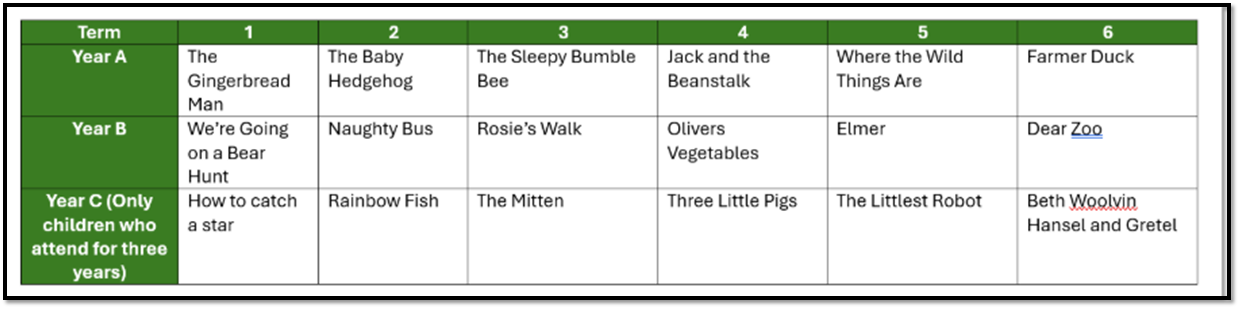
As in the main school and The Hive, our writing will be taught through the SEND adapted Talk for Writing Approach. Following the 3 I’s, Immersion, Imitation and Innovation, the children will learn an adapted 5 sentence story of the text. Each step of the learning journey will be linked to a key Talk for Writing text, these are in line with our mainstream curriculum or that of our specialist unit. These texts will run on a two-year rolling programme as many of our children will stay with us for two years. There is also a third year, closely linked to Year 1, for those who are with us for three years. Please see table for details:
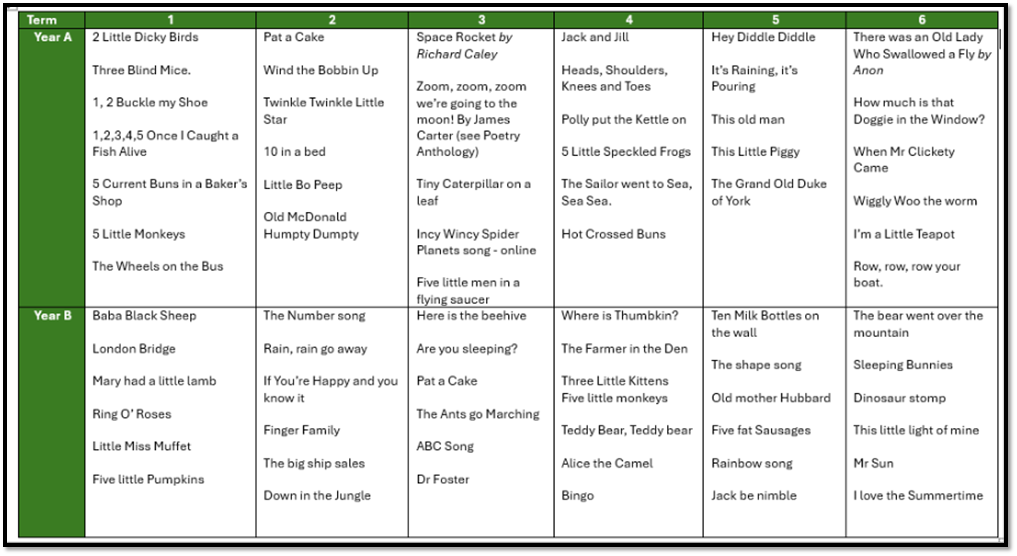
Due to their importance in early language development, each unit will be supported by six nursery rhymes or “rhymes of the week.”
Maths
In line with our Hive (specialist unit,) our maths will be taught using the “Maths for Life” curriculum. Children are assessed through a baseline assessment and then individual pathways through the curriculum are taught. Maths for Live aims to provide a practical, differentiated, and accessible math curriculum for students, especially those with additional learning needs, that prioritizes essential, functional skills for everyday life. The program's approach is based on building solid foundations, moving at an individual pace, and using real-world contexts and repetition to ensure deep understanding and retention. The goal is to empower learners to confidently navigate the modern world by securing the numeracy skills they need to thrive. This is achieved through the implementation of their five key principles:
-
Individualised learning: The program is specifically designed for students who struggle with the standard curriculum. It avoids a "one size fits all" approach and allows students to progress at their own pace, focusing on securing each skill before moving on.
-
Practical and functional skills: The priority is teaching the essential math skills needed for daily life, such as the numeracy skills for navigating the modern world.
-
Solid foundational knowledge: The program starts with pre-number skills ("Foundations") to build a strong base. It then builds understanding incrementally and logically across the curriculum.
-
"Little and often" approach: Instead of topic chunks, the program emphasizes regular, frequent practice and repetition throughout the year to deepen and retain understanding.
-
Real-world context: The materials use bright, bold visuals and relatable, real-world scenarios to make learning engaging and relevant.
-
Scaffolding: The program provides the necessary scaffolding for students with additional learning needs to achieve what neurotypical learners might take for granted.
The above are delivered with age-neutral content which focuses on empowering each individual pupil to be ready for the next stage of their mathematical learning.
Our Community
Community involvement is an essential part of our curriculum as we celebrate local traditions and learn new skills to enable the children to take an active role in events throughout the year.
Throughout their time in the NEST, the children develop a sense of belonging to our school community, ready to transition to future education in mainstream school or a specialist setting. This is fostered through involvement in house and whole school events such as the nativity, assemblies and celebration events as well as inclusive sessions with our mainstream and Hive peers.
We feel that it is vital for parents and families to be involved in their children’s learning, and we aim to achieve this through; regular Dojo communication and sharing of images, termly meetings with parents, sign posting to extracurricular activities and support services and our daily handovers to parents.
SEND/ Disadvantaged Children
Our curriculum is specialised and adapted to suit the needs of our learners as individuals. All learners within The Nest will have or will be on the path to receiving an EHCP. Targets from this will form the basis of our learning, being used to create and individualised learning plan (IEP) for each child. Children will have personal targets for all areas of learning; these will be worked on through a combination of taught sessions and structured play.
Children will be scaffold and supported in a way to best suit their needs through methods including but not restricted to symbolled communication, Makaton signing, AAC, SALT support, teacher of the deaf support, occupational therapy support, autism consultant support, targeted intervention, individual timetables and schedules and sensory support.
Impact
The impact of our provision in the NEST will be best measured by the readiness of our children to engage with the next step of their learning, be this a transition to mainstream, our SU or an alternative specialist setting. They will leave us more independent, resilient and more effective communicators. All our children will make measurable progress against their individual targets.
The impact of our curriculum is monitored and assessed using a range of statutory and non-statutory assessment frameworks to measure their progress through the various stages of their learning. Progress is updated, reported and tracked continuously through: “Evidence for Learning” tracking system that evidences progress made from individuals starting points. This is supported by formal and informal classroom observations which are recorded and monitored for each pupil. Each term, teachers meet with parents and provide them with a written report to outline progress against individual targets, usually taken from their EHCP.