Science
Intent
It is our intention to provide a diverse, knowledge-rich science curriculum which inspires our pupils to develop a fascination for and a deep understanding of the world around them. Our curriculum is aspirational, enabling and inclusive and ensures all children will:
-
Learn a wide body of scientific knowledge which fosters scientific curiosity.
-
Understand how science affects their everyday lives and develop a sense of responsibility for the world.
-
Make confident, meaningful links between their learning, the wider curriculum and the real world.
-
Understand what it means to study science and how this can influence their thoughts and actions both now and in the future.
-
See themselves as scientists and understand the role of a scientist in society.
-
Learn science through first-hand experiences - observe science in the real world and embed their scientific learning into meaningful contexts through scientific enquiry and enrichment opportunities.
-
Be prepared for the next stage in their scientific learning.
Throughout our science curriculum, learning is purposeful and, through the acquisition of knowledge and scientific enquiry skills, children will develop a solid understanding of scientific concepts and the relevance of these to the world in which they live. We intend for our science curriculum to be guided by six principles:
-
Curiosity – Children are encouraged to be curious, ask questions and be inquisitive about science and the world around them.
-
Purpose - Disciplinary and substantive knowledge are sequenced to ensure a progressive curriculum which builds on prior knowledge and is informed by assessment.
-
Inclusivity - Learning is inclusive and challenging for all; learning experiences are adapted to ensure all individual learning needs are met.
-
Inspiration - Children experience science in a real-life context through practical enquiry and enrichment opportunities which enable them to see the relevance of their learning.
-
Connectiveness - Teaching and learning exposes the links between science, the wider curriculum and the real world, such as engineering and medicine.
-
Aspirational - Children see themselves as scientists. They understand the role that scientists play in our understanding of scientific concepts and are aware of the scientific careers available to them.
Implementation Overview
At East Hunsbury Primary School, we implement our science teaching through an ambitious, high-quality science curriculum which is carefully constructed to ensure children develop a solid understanding of scientific concepts and knowledge. Substantive and disciplinary knowledge is sequenced in small steps which build upon prior knowledge and ensure that children develop their understanding over time; content is taught in such a way that it will be remembered and not just encountered.
Science is taught through six high-dividend concepts which are woven through the curriculum and form the ‘big ideas’ through which all science is taught: Energy, Forces, Matter, Earth and Space, Life and Evolution. Explicit links are made between these concepts. Our curriculum also incorporates explicit horizontal links across a year group; vertical links where knowledge and understanding are built upon from previous units and diagonal links where meaningful links are made across the wider curriculum.
Enquiry and the associated investigative skills are at the core of all science learning. Observing with a scientific eye, predicting, problem-solving, decision-making, communicating, thinking critically and evaluating are common threads which underpin all science learning. Where appropriate, our science curriculum is taught outside the classroom providing first-hand experiences of the local environment and allowing children to observe science in the real-world and embed their learning of science into meaningful contexts. Additionally, enrichment opportunities further enhance our science curriculum by providing pupils with the opportunity to focus and deepen their scientific learning and extend their educational experiences.
Impact
The impact of our curriculum will be assessed through a multi-faceted approach including:
-
Retrieval questions
-
Lesson outcomes
-
Teacher questioning
-
Pupil voice
-
Teacher voice
-
Hot and cold tasks
-
Book monitoring
-
Learning walks
-
Practical scientific enquiries
Pupil attainment in science is recorded on Insight annually at the end of the summer term.
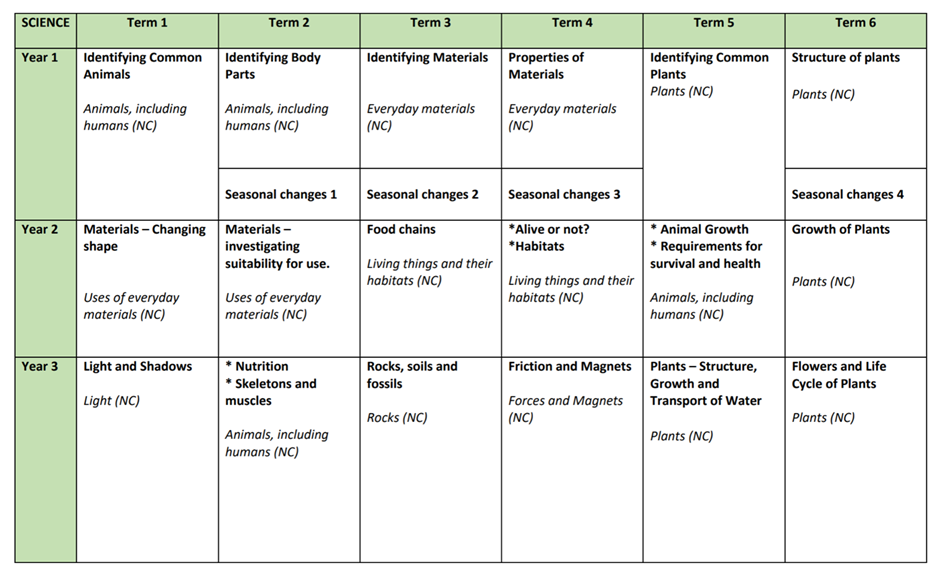
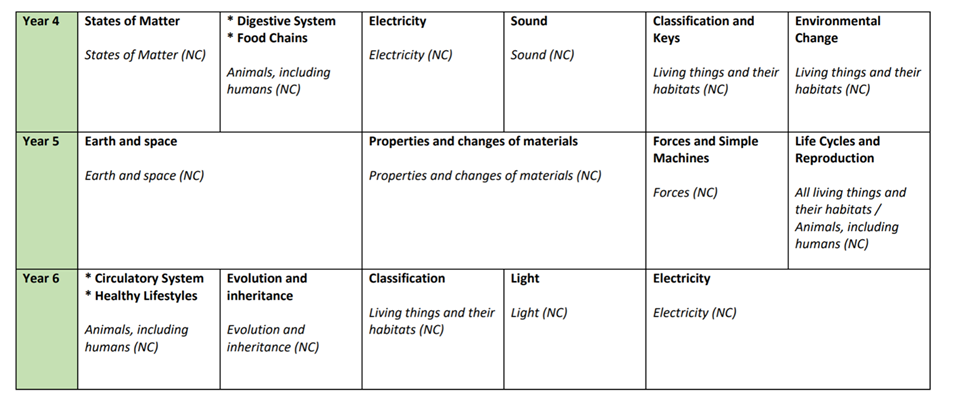
Science is taught in all year groups with weekly lessons throughout Key Stage 1 and Key Stage 2. Lessons are timetabled carefully to ensure that children receive at least 60 minutes of science teaching and learning in Key Stage 1 and at least 90 minutes in Key Stage 2. Within the Early Years, science is taught through carefully planned learning opportunities within the setting.
The science units taught through our curriculum are in line with the requirements of the National Curriculum. Within Key Stage 1, children learn about Plants, Animals (including Humans), Everyday Materials and their Uses, Seasonal Changes, and Living Things and their Habitats. The learning in these units is then built upon throughout Key Stage 2 with the addition of Rocks, Light, Forces and Magnets, States of Matter, Sound, Electricity, Properties of Materials, Earth and Space and Evolution and Inheritance. The teaching of the working scientifically skills is weaved throughout the curriculum with children demonstrating a progression in these disciplinary skills as they move through school.
We ensure that children understand the links between their science units and the wider curriculum through carefully planned links across subjects, for example the use of forces for mechanical systems in DT, health and well-being through PSHE and PE and the use of digital measuring equipment such as data loggers and its links with computing.