Religious Education

Intent

At East Hunsbury Primary School, Religious Education plays a key role in developing our children’s knowledge and understanding of the diversity of world views and belief systems. Our curriculum is aspirational, enabling and inclusive and it is our intention that it equips children with the skills to question, discuss and explore the cultures and beliefs of society.

We believe it is important to broaden children’s understanding of cultures and beliefs so we intend for our curriculum to prepare children to meet those who have different cultures and beliefs and to understand and develop acceptance and tolerance for those whose beliefs are different to theirs. At East Hunsbury Primary School, we consistently develop children’s spiritual, moral, cultural and social education, helping them to have a greater understanding of their place in the world.

At East Hunsbury Primary School, it is our intention that our Religious Education curriculum will:

  • Expand children’s knowledge and understanding of the six main religions.

  • Enable children to develop religious literacy by exploring and understanding a variety of religious and non-religious worldviews.

  • Teach children to reflect and discuss diversity and values.

  • Develop in every child a rich, deep knowledge and understanding of religious and non-religious worldviews and practices, providing a secure foundation that will enable them to succeed as they move to their next stage of education.

  • Promote tolerance, understanding and dispel prejudice to enable our children to be able to live, work and socialise in the wider community.

Our RE Curriculum aims to ensure that all children acquire and develop the knowledge and understanding of the diversity of world views and belief systems alongside an understanding of the influence these beliefs, values and traditions can have on individuals, communities and society. We intend for our children to develop respect for others who hold different views and beliefs from their own and to acquire the skills to question, discuss and evaluate information and form their own opinions.

For more information, please refer to the NPAT Religious Education Narrative

Info on Parental Withdrawal in RE

Parental right of withdrawal from RE This was first granted in 1944 when curricular RE was called ‘Religious Instruction’ and carried with it connotations of induction into the Christian faith. RE is very different now – open, broad and exploring a range of religious and non-religious worldviews. In the UK, parents still have the right to withdraw their children from RE on the grounds that they wish to provide their own RE. This provision will be the parents’ responsibility.6 This right of withdrawal exists for all pupils in all types of school, including schools with and without a religious designation. Students aged 18 or over have the right to withdraw themselves from RE. Parents also have the right to withdraw their child from part of RE, and can do so without giving any explanation. 6 School Standards and Framework Act 1998 S71 (3)

(National Association of Teachers of Religious Education) 

If you feel you would like to withdraw your child from RE please contact your class teacher who can arrange a meeting with the RE Lead to discuss your concerns.


Implementation Overview

At East Hunsbury Primary School, we implement our RE teaching through an ambitious, high-quality RE curriculum which is carefully constructed to ensure that children develop a solid understanding of the diversity of world views and belief systems and an understanding of the effects that beliefs, values and traditions can have on individuals but also communities. Substantive, disciplinary and personal knowledge is sequenced in small steps which build upon prior knowledge and ensure children develop their understanding over time.

Religious Educations is taught through four high-dividend concepts which are woven through the curriculum and form the ‘big ideas’ through which all RE is taught: Belief, Community, Festivals and Worship. Explicit links are made between these concepts. Our curriculum also incorporates explicit horizontal links across a year group; vertical links where knowledge and understanding are built upon from previous units and diagonal links where meaningful links are made across the wider curriculum.

We ensure that, throughout our RE curriculum, children build their knowledge of both religious and non-religious world views and develop respect, understanding and empathy for others.


Impact

By the end of Key Stage 2, our children will demonstrate sound knowledge of the diversity of world views and beliefs. Our children develop respect and appreciation for others who hold different beliefs and views from their own and question, discuss and evaluate information to form their own opinions. Our curriculum intent will be fulfilled.

The impact of our curriculum will be assessed through a multi–faceted approach including:

  • skilful questioning lesson by lesson,

  • high quality discussion with teachers during lessons, addressing misconceptions,

  • weekly retrieval practices,

  • lesson quizzes,

  • appropriate writing outcomes and

  • end of unit summative tasks.

Evidence of learning is recorded within Religious Education books and teachers assess against the RE learning outcomes for each lesson and/or unit. Leaders will monitor the quality and impact of the RE curriculum through book-looks, pupil voice and lesson visits and assess which pupils know more and remember more. Pupil attainment in RE is recorded on Insight annually at the end of the summer term.
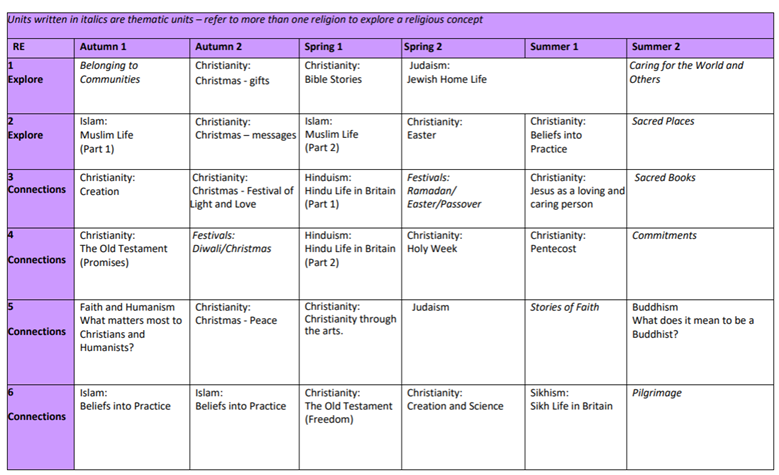
RE is taught weekly in all year groups for an hour a week throughout Key Stage 1 and Key Stage 2.  Within the Early Years, RE is taught through carefully planned learning opportunities within the setting. The units taught are in line with the National Curriculum and the Sacre and have been carefully planned to ensure there is a sequenced progression which builds understanding and knowledge. Within Key Stage 1, children learn about Christianity, Judaism and Islam. The knowledge of these religions is then built upon throughout Key Stage 2 where they learn about each belief in more detail but also begin to develop their understanding of Hinduism, Buddhism and Sikhism.

Our Religious Education learning starts in the Early years where, through Personal Social Emotional Development and Understanding the World, children learn in a carefully planned environment that enriches children’s personal experiences to increase their knowledge and sense of the world around them. They listen to a broad selection of stories which foster their understanding of our culturally and socially diverse world and will learn to:

  • Show sensitivity to their own and other’s needs

  • Talk about the lives of people around them and their roles in society

  • Know some similarities between different religious and cultural communities in this country, drawing on their experiences and what has been read in class

  • Recognise that people may have different beliefs and celebrate special times in different ways.

The Religious Education curriculum is underpinned by research in cognitive science. Understanding builds on the knowledge taught within the Early Years and subject specific vocabulary is explicitly taught every lesson. Lessons have been sequenced to ensure that children develop a secure understanding of key religious worldviews.

Building on from the Early Years, in Key Stage 1, children develop their knowledge and understanding of beliefs and practices in Christianity, Judaism and Islam. They are encouraged to raise questions and begin to express their own views whilst learning to respectfully disagree with each other. Throughout Key Stage 2, children will make connections between their knowledge and understanding of Christianity and the religious traditions and beliefs in Judaism, Islam, Hinduism, Sikhism, Buddhism and those of no faith. They are encouraged to use reasoned arguments and debate to explore controversial views and explore current social injustice within the world.

Enrichment goes beyond the curriculum requirements for the teaching of RE at East Hunsbury Primary School. We impact on the children’s learning by creating memorable experiences both in the classroom and beyond. Examples of this are:

  • Year 2 visit to our local Church St Benedict’s to support learning of ‘Christian Belief’s into practice.

  • In Year 5, children engage in the workshop ‘Easter Cracked’ linking their learning on Christianity through the arts and stories of faith.

  • In Year 6, children participate in ‘Christmas unwrapped’ reviewing and expanding on their previous learning in Christianity – Christmas and peace Year 5), Festivals (Year 4) and Light and Love (Year 3). Finally, at the end of Year 6, we visit Queen’s Park for their Faith Tour where children explore 4 different Religious World views.

At East Hunsbury Primary School, the British Values of Democracy, The Rule of Law, Individual Liberty and Mutual Respect and Tolerance of those with different faiths and beliefs are embedded within our RE curriculum. All units of the curriculum focus on Mutual Respect and Tolerance of those with different faiths and beliefs and Individual Liberty. Children explore issues such as Democracy and Rule of Law as they are reflected in religious and worldview contexts and relate them to their own experiences through studying the impact of religious texts and stories, historic contexts and cultural differences. In Upper Key Stage 2, children are encouraged to evaluate all arguments in debate and to examine philosophical and social theories and problems, such as science and creation, as well as the impact of discrimination and addressing stereotypes (for example: the unit “What matters most to Christians and Humanists?” and “Islamic life in Britain” are opportunities to address the stereotypes and misconceptions that may form around these worldviews.) 

Teaching children to respect and value diversity is encouraged in the day-to-day teaching and learning through showing respect for different viewpoints and ideas. The children are encouraged to work effectively together both individually and in groups and to have the confidence to express their ideas and opinions regarding religious issues such as pollution, environmental issues and globalisation. 

The National Curriculum recognises how important it is for children to understand the world in which they live. At East Hunsbury Primary School, we want children to live alongside and show respect for a diverse range of people. We provide children with the knowledge and skills to do this through the teaching of protected characteristics within our RE curriculum. Examples where these are demonstrated are: 

  • Marriage and Civil Partnerships (Belonging to Communities – Year 1; Jewish Home life -Year 1; Muslim Life – Year 2 and Commitments Year 4)

  • Religion or belief (throughout all areas of the curriculum)

It is extremely important for us that our children grow up to be respectful, ambitious and empathetic citizens who respect the world in which they live in and the people with whom they live alongside.  

We ensure that every child has what they need to succeed within RE. Our RE curriculum is ‘inclusive by design’. It is our ambition for all our pupils to access the full RE curriculum and quality first teaching enables this. Support for pupils with SEND or disadvantaged pupils is given by careful individual and/or group support to enable them to secure the knowledge they need to continue to access content in RE.

Our RE curriculum caters for the different groups within our school. The teaching and learning supports the children’s individualised needs. We achieve this by creating opportunities for children by: 

  • Using visual supports

  • Scribing work

  • Outside learning

  • Hands-on practical application and tasks

  • Sensory experiences

  • Visits and visitors 

  • Use of technology to assist and explore

Beyond the curriculum, pupils’ knowledge and skills in RE are developed through opportunities and activities within the community.

As part of the ‘Our World’ Education team, children engage in learning for Earth Day, participate in house events to create a thoughtful Christmas Tree decoration for St. Benedict’s Christmas Tree Fayre and joining in an art project which culminates in our children participating in the Northampton Diwali parade. These opportunities develop the children’s sense of pride and responsibility for their community, environment and the wider world.