Early Years
At East Hunsbury Primary School, we want our children to be lifelong learners who are enthusiastic, curious and creative. We want them to be well rounded, confident citizens of the world who can play and explore, create and think critically, be resilient and to learn. Our curriculum is ambitious and tailored to suit the needs and next steps of all learners. The knowledge our children gain from our enriching and challenging curriculum gives them the start they need to succeed in life, preparing them for future schooling.
The Early Years Foundation Stage is the period of education from birth to 5 years. In our Foundation Stage we have two reception classes. We work closely with the feeder nurseries and pre-schools and the families of our pupils.
Our curriculum is not only underpinned by the Characteristics of Effective Learning but also our values and drivers which are unique to our school and setting. Our values and drivers have been carefully chosen to ensure that the curriculum is taught in a way that meets our children’s learning and SEMH needs (Social, Emotional, Mental Health) and prepares them well for the next phase of their education and lives.
Intent
It is our intention that the Early Years at East Hunsbury Primary School will provide a robust and solid foundation on which children will grow, learn and develop into lifelong learners. This developed through our Curriculum Drivers and Values that underpin all of our teaching and learning.
Our Early Years Values are:
kindness, perseverance, gratitude
These values have been carefully chosen for our EYFS because they allow children to develop positive learning behaviours and to become good citizens. Children who are kind can empathise, share and consider the feelings of others as well as themselves. Children who can persevere can keep trying even when things get difficult, they can take a step back and consider different ways of approaching a problem. Children who show gratitude are open to learning experiences and help and can offer help to others. These values are evident throughout our provision and opportunities to develop them are carefully planned within our curriculum. With these values in place our children will learn and grow, developing a lifelong love of learning.
Our Curriculum Drivers are:
independence, communication, learning Everywhere
A curriculum driver is a thread or ‘vehicle’ that runs through our teaching and learning, it drives our provocations and stimuli and underpins our exploration of the interests of our children. It is our intention that these drivers are evident throughout our EYFS curriculum and influence all of the teaching that happens at East Hunsbury Primary School.
Independence
Rationale: As lifelong learners, we want our children to be:
-
responsible learners who take ownership of their learning,
-
resourceful learners who seek solutions for themselves.
Aim: We aim for our children to be:
-
Independent learners
-
Independent thinkers
-
Creative thinkers
Communication
Rationale: As lifelong learners, we want our children to be confident speakers and attentive listeners in order to express themselves and understand others.
Aim: We aim for our children to be:
-
Effective speakers
-
Attentive listeners
-
Confident communicators
Learning Everywhere
Rationale: As lifelong learners we want our children to be curious, to love learning and to see opportunities for learning in their world.
Aim: we aim for our children to embrace learning through:
-
Opportunities in the classroom
-
Opportunities beyond the classroom
-
Opportunities in their home life.
As previously mentioned, the Characteristics of Effective Learning also support, and are integral to, our curriculum.
Implementation Overview
Our EYFS curriculum in driven by the interests of our children and is informed by educational research and pedagogy, alongside advice from experts in the field.
Our curriculum is influenced by the research of Rosenshine and Vygotski, among others, and considers current thinking from EYFS experts such as Julian Grenier, Alistair Bryce- Clegg and Greg Bottrill to name a few. We will follow Vygotsky’s (1978) zones of proximal development when modelling to and teaching our children:
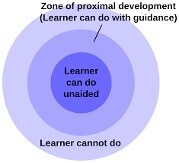
With a combination of direct teaching and play based learning, we will scaffold the children to work from adult-lead to adult-initiated and ultimately child-initiated learning/application whilst continually considering the outlined research.
Implementation of Drivers and Values
Our drivers and values will be introduced to the children on a termly basis, in the autumn we will explore kindness and Independence, in the spring, perseverance and communication and in the summer gratitude and learning everywhere. This will be a cumulative exploration and we will continue to refer to previous drivers and values as the term progresses. By the end of the summer term our children will have been exposed to all 3 values and drivers and will be used to hearing them referred to throughout the provision.
Phonics, Handwriting, Maths
Phonics, Handwriting, Writing and Maths will be taught using whole-school carefully researched approaches; Sounds-Write, Kinetic Letters, Talk for Writing and Maths Mastery respectively. All of these approaches are based in sound pedagogy and are appropriate to the age and developmental stage of our children. It is important that all learning and our school curriculums start from the Early Years therefore, these approach run throughout the whole school.
Early Reading
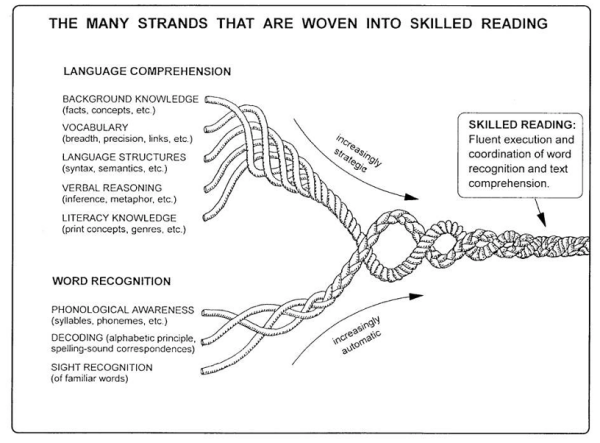
Early Reading is a crucial skill, it has been recognised by many educationalists as a key component to learning. Phonics is a large part of this in the early years, but reading is so much more than simply being able to decode words. When teaching reading, we want to promote a love of books and an understanding of the text. Children will hear multiple stories, poems and nursery rhymes every day at East Hunsbury Primary School, we will read class novels, picture books and non-fiction texts. We will use the Scarborough Reading Rope to weave together the skills needed to become a reader:
Reading for pleasure will be promoted in variety of ways including: carefully resourced ‘Book Nooks,’ in each classroom, books in all areas of the provision, story play and storytelling, weekly library books and sharing children’s and teacher’s favourite books. In fact, our EYFS classes are named after two children’s authors: Nick Sharratt and James Carter and we will interact with them regularly.
Learning Pathway
To ensure that all areas of the Early Years Foundation Stage are covered, we have mapped out our ‘Learning Pathway,’ this will be informed by the children’s engagement and involvement and is designed to evolve with our children.

The provocations/ stimuli that we propose are:
|
|
Autumn 1 |
Autumn 2 |
Spring 1 |
Spring 2 |
Summer 1 |
Summer 2 |
|---|---|---|---|---|---|---|
|
Potential Provocation |
Favourite Things Toys Families Food Books Activities |
Light Dark den Light boxes Sources of light Candles Stars Festivals of light |
Space Stars Planets Astronauts Space travel |
Earth Towns, cities, countryside, forests, beaches, ponds, lakes, rivers, the sea |
Growing Growing plants Conditions needed for growth Life cycles Changes in plants and animals |
Beasts Mini-beasts and bugs Animals Dinosaurs Mythical creatures |
These are linked to allow for joined up thinking, supported by research in Cognitive Science, allowing for retrieval practice and interleaving to become a part of daily teaching and learning.
Through these provocations and the exploration of the interests of our children we will ensure that they have the opportunity to discover and experience a variety of cultural opportunities to help them all progress and achieve success.
Our Community
Community involvement is an essential part of our curriculum as we celebrate local traditions and learn new skills to enable the children to take an active role in events throughout the year.
Throughout their time in EYFS, the children develop a sense of belonging to our school community, ready to transition to Year 1. They have the confidence and skills to make decisions and self-evaluate, make connections and become lifelong learners.
Impact
By the end of Reception, our pupils will have begun to develop a lifelong love of learning. They will be independent, communicative and see their world as a learning opportunity. They will all make good progress, and the majority will meet their Early Learning Goals.
The impact of our curriculum in monitored through:
-
Continuous formative assessment through close observations by skilled practitioners. We value each child as individual and unique and look closely at their stage of development, setting next-step targets to help them to continue to progress as throughout the year.
-
At the end of the Reception Year, we will summatively assess children against the Early Learning Goals, providing our children, parents and Year 1 team with the opportunity to both celebrate success and plan targets for further development.
-
We will use the Leuven Scale measurements of wellbeing and involvement.
-
We will be influenced and informed by the NPAT EYFS framework and moderate judgements with other schools.