Art and Design
Intent
At East Hunsbury Primary School, we intend for our art curriculum to enrich our children’s experience of life aesthetically, culturally and personally. We believe that by appreciating and making art, children learn to express and value their unique voice and viewpoint of the world. This helps pupils understand themselves, their place in the world and gives them a sense of wellbeing; thereby helping to unlock their full potential and introducing children to the highest form of creativity.
We intend for our art curriculum to be aspirational, enabling and inclusive as well as:
-
Accessible,
-
Relevant,
-
Progressive,
-
Inspirational,
-
Challenging and
-
Enjoyable for all our children.
It is our intention that that our curriculum will equip the children with the knowledge and skills to experiment, invent and create their own works of art, craft and design.
We intend that our children will have the opportunity to enjoy Art and Design in its many forms and acquire the skills and technical vocabulary to critique and appreciate a range of artists from different periods, cultures and genres.
We intend for our curriculum to teach the children to think critically about great artists, craft makers and designers, and understand the historical and cultural development of their art forms and how they impact on our lives today.
Our Art Curriculum meets the expectations of the National Curriculum as set out below:
During KS1, children will be taught to:
-
Use a range of materials creatively to design and make products.
-
They will use drawing, painting and ceramics to develop and share their ideas, experiences and imagination.
-
They will study an artist in depth and be taught the language to describe the differences and similarities between different practices and disciplines as well as making links to their own work.
-
Children will have the opportunity apply their drawing skills to illustrate a piece of work within the curriculum that has been brought up to presentation standard during each year.
During KS2, children will continue to build on, improve and develop:
-
Their techniques, including their control and their use of materials, with creativity, experimentation and an increasing awareness of different kinds of art, craft and design.
-
Their mastery of art and design techniques in drawing, painting and ceramics.
-
They will continue to be taught about and be inspired by the work of artist and craftspeople and will use what they have learnt to inspire and critically inform their own work.
-
Children will have the opportunity to apply their drawing skills to illustrate a piece of work within the curriculum that has been brought up to presentation standard during each year.
For further information about our art curriculum, please refer to the NPAT Aims and Principles documents and the Art Narrative.
Implementation Overview
At East Hunsbury Primary School, our art Curriculum is made up of three strands:
-
mastery in drawing, painting and sculpture, (including experience of other additional art forms and working with an artist in residence as part of the Royal Shakespeare Company project in Year 5),
-
illustration of work and
-
development of art appreciation, (including exploring prominent artworks and artists within the National Gallery’s collection as part of the Take One Picture project in Year 4).
The following high dividend-concepts have been identified as part of the art and design curriculum:
-
colour,
-
line,
-
tone,
-
texture,
-
pattern,
-
shape and form
-
composition
These strands form the ‘Big Ideas’ through which all art forms will be taught and teachers will make explicit reference to where children have met these concepts before in the curriculum.
Impact
At the end of our art curriculum, pupils will have a secure understanding of artistic skills and knowledge related to the six high-dividend concepts. Using this knowledge, they will be able to make meaningful connections between their work, the work of other artists and its context in the wider world. Pupils will have well-developed analytical skills which enable them to think critically, ask questions and articulate their understanding. They will be able to evaluate works of art, including their own, and use this appreciation to inform their own work. Pupils will be confident about experimenting, taking risks and solving problems when creating their work.
The impact of our curriculum will be assessed through a variety of methods including:
-
Weekly retrieval practise
-
Precise lesson outcomes
-
End of unit tasks
-
Learning walks
-
Book monitoring
-
Professional dialogue
-
Pupil voice and staff voice
Pupil attainment in art is recorded on Insight annually at the end of the summer term.
Art is taught in the first, third and fifth term of the school year. The teaching of art equates to 1 hour of teaching time per week but this time may be taken in a block within the unit. For effective planning, time is also utilised in the best way to ensure that relevant links are made between the art curriculum, the wider curriculum and enrichment opportunities.
Children are taught to master skills in drawing, painting and sculpture through a series of lessons which are cumulative in skill progression. The mediums for sculpture alternate yearly between ceramics and recycled materials. Children experience and explore other media, such as: printmaking, photography and textiles through opportunities in other areas of the curriculum e.g. DT or computing. Similarly, the skills taught through art are also linked to other areas of the curriculum, e.g. the drawing of historical buildings in history.
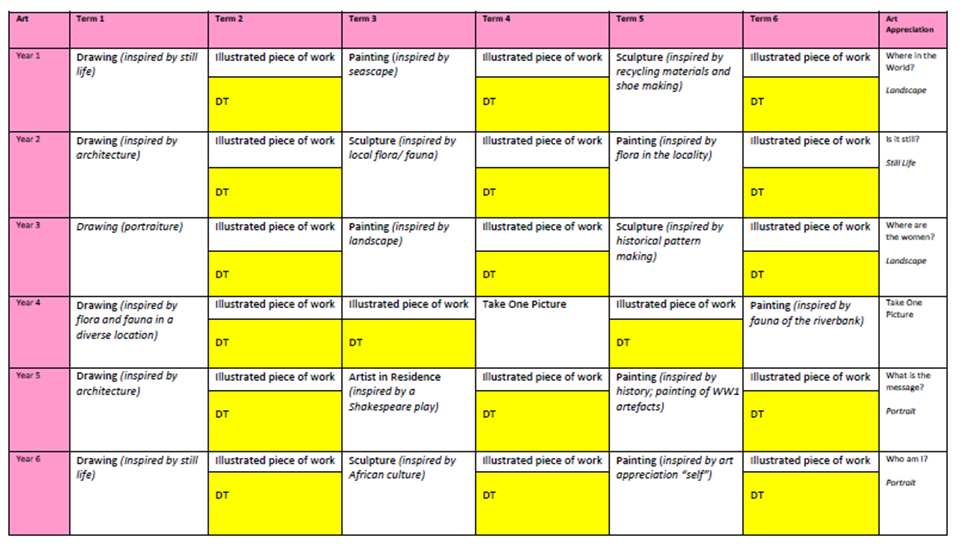
Our art curriculum is sequenced to ensure there is progression in learning throughout and that knowledge builds upon prior knowledge. We also ensure that relevant links are made within the art curriculum and across the wider curriculum. For example:
-
Horizontal links will be explicitly made e.g. the mark making that children complete in the art drawing units lead into brush control in the painting units. All painting units will also start with an observational drawing.
-
Vertical links will be made where knowledge and understanding are retrieved and built upon from previous art units e.g. in Year One, the children will be introduced to the concept of tone and making dark and light markings to three tonal values. In Year Two, this advances to four tonal values and by Year Three they will be marking to six tonal values.
-
Diagonal links will be made, particularly where this is cross-curricular e.g. in the Year Two drawing unit, the children will draw local landmarks which they have previously learnt about within history.